
THURSDAY 7/5/2025 – COUNTING THE VOTES
Introduction
Inside the Sistine Chapel, the cardinals have cast their ballots. Now comes one of the most solemn and precise stages of the papal conclave: the counting of the votes. Every moment of this process is conducted with utmost care, transparency, and reverence. The scrutiny of ballots is designed not only to determine the outcome but to uphold the integrity of the election. From the shaking of the urn to the thread drawn through each vote, the process is ancient and deeply symbolic. It reflects the Church’s commitment to truth, fairness, and divine discernment. As the world waits outside for a signal—black smoke or white—the electors inside proceed with quiet purpose. Their responsibility is immense, and every vote counted brings them one step closer to declaring Habemus Papam — “We have a Pope.”
Counting the Votes
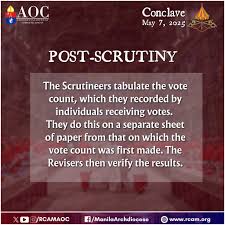
After all the electors have cast their ballots, the first Scrutineer shakes the urn to mix the papers thoroughly. The last Scrutineer counts each ballot carefully, transferring them one by one to another container in full view of the assembly. If the number of ballots does not match the number of electors, they are all burned and the vote is repeated. If the count matches, the Scrutineers proceed. One by one, the ballots are read: the first Scrutineer opens and notes the name; the second confirms it; the third reads it aloud to the electors and records it. Each ballot is then pierced with a needle through the word Eligo and threaded together, secured at both ends to prevent tampering. The final tally is noted, and the results are reviewed in preparation for the next step—either a new vote or the declaration of a newly elected pope.
Impasse
Not every conclave ends quickly. If no one reaches the required two-thirds majority, the process continues with additional ballots—up to four per day. After three full days of voting without a result, the cardinals pause for a day of prayer and discussion. If, after more ballots, an impasse continues (usually after about 33–34 votes), the Camerlengo consults the College to decide how to proceed. However, even in extreme circumstances, the rules remain clear: a two-thirds majority is always required for a valid election. This was reinforced by Pope Benedict XVI in 2007, who revoked earlier provisions that allowed for a simple majority under certain conditions. In theory, a non-cardinal could be elected pope, provided he is deemed capable of carrying the responsibilities of the Petrine office. However, this is highly unlikely. The last such election—Urban VI in 1378—plunged the Church into the Great Western Schism. The conclave, by design, favors unity, discernment, and continuity.
Some Stats
Though modern conclaves are typically brief, history offers examples of lengthy and complex elections. The longest interregnum lasted over two years—from 1268 to 1271—ending in the election of Gregory X. By contrast, recent elections have taken just days:
- Pope Pius XII (1939): elected in two days
- Pope John Paul I (1978): elected in one day
- Pope John Paul II (1978): elected in three days
- Pope Benedict XVI (2005): elected in two days
- Pope Francis (2013): elected in two days
The number of ballots cast during these conclaves remains secret, and though meticulous records are kept, they are sealed and archived for posterity. The efficiency of modern conclaves owes much to preparatory reforms and clear canonical procedures, but the spirit of prayerful discernment remains unchanged.
Conclusion
As the vote-counting concludes, the outcome becomes clear. If a candidate has achieved the required majority, the process moves swiftly to confirmation. The Secretary of the College and the Master of Papal Liturgical Ceremonies are summoned. The Dean of the College then asks the elected candidate: “Do you accept our canonical election as Supreme Pontiff?” Upon his acceptance, the next question follows: “By what name do you wish to be called?” The newly elected pope is then led to a room behind the Sistine Chapel, where he exchanges his cardinal’s red for the white vestments of the papacy. Three cassocks await him—small, medium, and large—ready to clothe him for his new office. After prayer and preparation, he returns to the chapel to receive the homage of the cardinals. Outside, the senior Cardinal Deacon appears on the balcony of St. Peter’s Basilica to announce to the world: “Habemus Papam!” Moments later, the new pope steps forward and delivers his first apostolic blessing Urbi et Orbi — to the City and to the World. The conclave is over. The Chair of Peter is once again filled. And with it, a new chapter in the Church’s story begins.
Resource: https://www.killaloediocese.ie/wp-content/uploads/2018/05/6319_6319_Conclave_Mgr_Charles_Burns_EX48.pdf